Meet the Candidate: Patti Ross Loya Brings 35 Years in Public Education to Mercedes
Editor’s Note: The Mercedes Enterprise invited all candidates running for school board to participate in its Meet the Candidate Q&A. The following are the responses submitted by Dr. Loya.
TME: Please introduce yourself to Mercedes ISD voters. What is your professional background, community involvement and connection to Mercedes ISD?
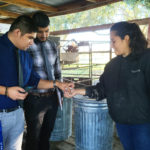
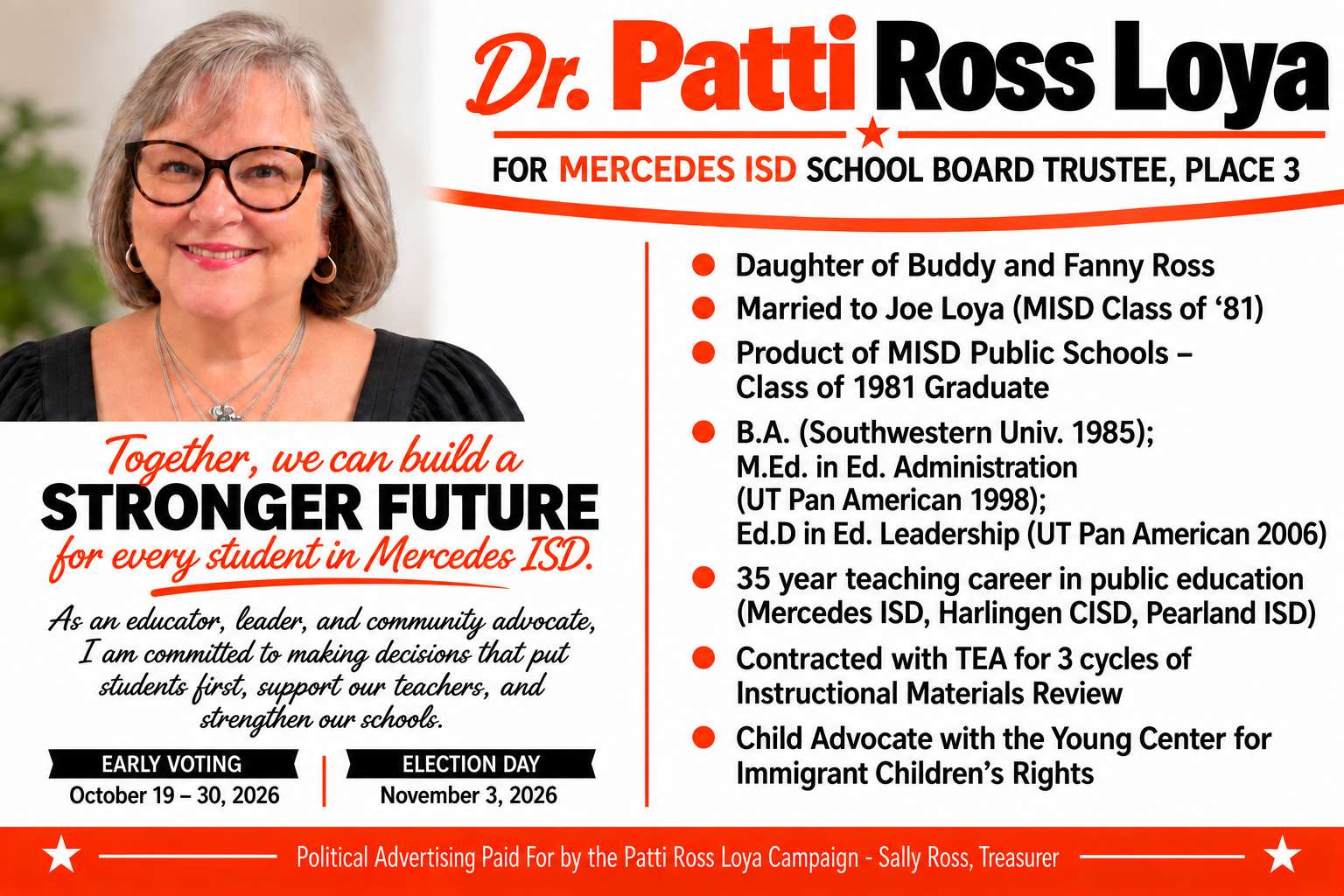
Dr. Loya: I am Patti Ross Loya, a proud lifelong product of Mercedes public schools. I was raised in Mercedes by Buddy and Fanny Ross. I attended Mercedes ISD from kindergarten through 12th grade, graduating third in my class from Mercedes High School in 1981. My roots in this community run deep, and my commitment to public education began as a student right here in Mercedes. I attended Southwestern University in Georgetown, Texas, earning my Bachelor of Arts degree in 1985. In 1987, I returned home to Mercedes and began my career in education as a fifth-grade teacher at Taylor Elementary. I spent 14 years serving Mercedes ISD, including my final four years as an Instructional Facilitator. During those years, I continued my own education at The University of Texas–Pan American, earning a Master’s Degree in Educational Administration. Throughout my career, I pursued additional certifications in Gifted and Talented Education, English as a Second Language, Mid-Management Administration, and Secondary Social Studies Composite. I also began my doctoral studies at UTPA and eventually took a two-year hiatus from teaching to become a full-time doctoral student and research assistant. I earned my Doctorate in Educational Leadership and returned to the classroom, continuing a 35-year career dedicated to public education. My career took me to Harlingen CISD, where I taught for four years at Coakley Middle School, and then to Pearland ISD, where I spent 17 years teaching at Carleston Elementary. Over the course of my career, I had the privilege of teaching students in grades 1, 3, 4, 5, 6, and 7. These experiences gave me a broad perspective on the educational needs of children at different stages of their development and reinforced my belief that every child deserves the opportunity to succeed. After retiring in 2025, my husband and I made the decision to come home to Mercedes. We wanted to be closer to the family, friends, and community that have always meant so much to us. Retirement, however, has not meant stepping away from service. It has given me new opportunities to serve our community and continue working with children. I became a certified Texas Master Gardener and a certified Texas Master Naturalist, participating in volunteer projects throughout the Rio Grande Valley. I have volunteered at Estero Llano Grande State Park, the National Butterfly Center, the East Foundation’s El Sauz Ranch, and Sea Turtle Inc. I have helped with school field trips, guided students through nature activities, participated in reforestation projects with Santa Ana National Wildlife Refuge and the U.S. Fish & Wildlife Service, and volunteered with youth activities at the Hidalgo County 4-H Ag Show and the Rio Grande Valley Livestock Show Citrus and Vegetable Show. I also serve on the Keep Mercedes Beautiful Committee for the City of Mercedes and am a member of The Chorus of the Rio Grande Valley, where I sing soprano I. Most importantly, my passion for children and public education continues. I serve as a Child Advocate through The Young Center for Immigrant Children’s Rights, working with unaccompanied minors in the custody of the U.S. Department of Health and Human Services. I am also a Texas Ambassador for The Reading League and have contracted with the Texas Education Agency as a reviewer in three cycles of the Instructional Materials Review and Approval process, evaluating instructional materials for inclusion on the Commissioner’s List of Approved Instructional Materials. After 35 years as an educator, I retired from the profession—but I did not retire from my passion for children, education, or my hometown. Mercedes ISD helped shape who I am. I believe in the power of public education because I have lived it—as a student, a teacher, an instructional leader, and as a community member. I want to use my experience, knowledge, and love for Mercedes to help ensure that our schools continue to provide every student with the opportunity to learn, grow, and succeed.
TME: Why are you running for the Mercedes ISD Board of Trustees, What motivated you to seek election to the school board?
Dr. Loya: As a young adult, I made a decision that would shape the course of my life: I wanted my life’s work to be about something bigger than myself. I wanted to devote my time, energy, and talents to serving others and making a positive difference in the lives of those around me, especially children. That became my “why”—the purpose that has guided both my personal and professional life. It is the same purpose that continues to guide me today. I am running for the Mercedes ISD School Board because I believe my 35 years of experience in public education, my educational background, my deep roots in Mercedes, and my continued commitment to children and our community can be valuable to our school district. I have experienced public education from many perspectives—as a Mercedes ISD student, classroom teacher, instructional facilitator, doctoral student, educational leader, and community volunteer. I have seen firsthand the difference that dedicated teachers, strong leadership, high expectations, and a supportive community can make in the life of a child. I have also seen the tremendous opportunities that a quality public education can provide. Mercedes ISD and this community gave me an exceptional foundation. The teachers, schools, and people of Mercedes helped shape the person I became and played an important role in the life I have been fortunate enough to build. I have never forgotten that. Now, after a 35-year career in public education, I have returned home. I believe this is an opportunity to give back to the district, the students, the families, and the community that gave so much to me. My “why” has not changed. I still want my life’s work to be about something bigger than myself—and I believe serving the students and families of Mercedes ISD is one of the most meaningful ways I can continue to make a difference.
TME: What do you believe are the three most important issues facing Mercedes ISD today?
Dr. Loya: First, and always at the top of my list, is school safety. For students, teachers, staff, and everyone who enters our schools to be successful, they must feel safe, secure, and supported. School safety encompasses much more than the physical security of our buildings and transportation systems. It also includes the well-being of our students and staff and our efforts to address issues such as mental health, bullying, substance abuse, and drug awareness. I am not suggesting that Mercedes ISD is an unsafe district. Rather, I believe that safety should always remain at the forefront of our priorities. We have a responsibility to continually evaluate our safety practices, identify areas where we can improve, and ensure that our students and staff have an environment in which they can learn and work without fear. Second is financial responsibility and sustainability. Money is always an issue for a school district because the needs are great and resources are limited. In recent years, Mercedes ISD faced significant financial challenges and found itself operating in the red. Fortunately, under the leadership of the superintendent and the guidance of the School Board, the district has worked its way out of that financial situation and is proposing a balanced budget for the 2026–27 school year. I believe that is an important accomplishment, particularly at a time when many neighboring districts are facing difficult financial decisions and proposing deficit budgets. At the same time, maintaining a sound financial position will continue to be a priority. The challenge is to be good stewards of taxpayer dollars while ensuring that our students and staff have the resources and educational opportunities they need to be successful. Financial decisions should always be evaluated through the lens of our mission: How does this investment support student learning and success? Third, and certainly no less important, is student achievement and progress— for every student, every student group, and at every level. Ultimately, student learning is at the heart of everything a school district does. We must know where our students are succeeding, where gaps exist, and what strategies and resources are needed to help every student reach his or her full potential. Student achievement should not be viewed simply as a set of test scores. It includes academic growth, readiness for the next level of education, graduation and post-secondary readiness, and ensuring that students leave Mercedes ISD prepared for whatever path they choose after high school. As a School Board, our responsibility is to establish clear expectations, monitor progress, ask thoughtful questions, and ensure that the district has effective plans and resources in place to support student success. School safety, financial responsibility, and student achievement are interconnected. When our students feel safe, when our resources are used wisely, and when our educators have the support they need, we create the conditions for every student to succeed.
TME: What do you believe the district can do to better support teachers while maintaining accountability for student outcomes?
Dr. Loya: Teachers want—and deserve—to be valued as the professionals they are. It will always be important for the School Board to work diligently to provide competitive compensation for teachers and all school staff. At the same time, we recognize that budgetary and fiscal realities can sometimes limit what is possible financially. That makes it even more important that the district create a culture and working environment in which teachers and staff feel respected, supported, heard, and valued. Teachers also want a meaningful voice in decisions that affect their classrooms, campuses, and district. One practice I have seen be particularly effective is a District Education Improvement Committee (DEIC). This committee is composed of representatives elected by their campus peers who meet regularly with Central Office administration. A DEIC can provide an important two-way avenue for communication. The superintendent and Central Office administrators can share information about district initiatives, projects, and plans while giving teacher representatives an opportunity to ask questions and provide feedback. At the same time, teachers can bring forward concerns, observations, ideas, successes, and celebrations from their campuses so that district leadership remains aware of what is happening in classrooms and across the district. The purpose of a DEIC should not be to create another forum for complaints or grievances. Rather, it should be a collaborative space to build awareness, share information, identify solutions, and strengthen communication between teachers and district leadership. Ultimately, the goal is to work together to create a better educational environment for everyone—and, most importantly, for our students. Another important area of focus must be the recruitment and retention of excellent teachers. While hiring personnel is not a direct responsibility of the School Board, the Board does have an important role in establishing policies, procedures, priorities, and resources that create an environment where outstanding educators want to work and build their careers. We should continually ask ourselves important questions: Do our district goals—and our number one goal should always be student achievement and progress—align with our policies and practices for supporting teachers? Are we providing the professional development, training, coaching, and mentoring teachers need to be successful? Are we allocating appropriate resources to recruit, support, and retain our best educators? And when the answer to any of these questions is no, we must ask what changes are needed and how the Board, working collaboratively with the superintendent and district leadership, can help bring our policies, practices, and resources into better alignment with our goals. When we talk about accountability, I believe it is important to recognize that classroom teachers can sometimes feel as though the responsibility for student achievement rests almost entirely on their shoulders. It shouldn’t. The School Board and district administration have a responsibility to establish clear expectations, measurable goals, and systems for monitoring progress toward those goals. Teachers should have ownership in achieving those goals and should receive timely feedback, resources, and support when adjustments are needed. Accountability and support must go hand in hand. We should hold ourselves to high expectations while also creating an environment in which teachers feel comfortable asking for help, sharing challenges, and seeking the resources they need to be successful. The following quote represents well my thinking of accountability: “It takes a team of intentional trustees working with a focused superintendent and an effective instructional team to improve student learning in a district. Teachers can’t do it alone. Administrators can’t do it alone. And school boards can’t do it alone. Everyone—from the boardroom to the classroom—must be focused and intentional when it comes to improving student learning.” This is what it is about: working together, supporting one another, holding ourselves accountable, and keeping student success at the center of everything we do.
TME: If elected, what is the first issue you would like the board to address?
Dr. Loya: Honestly, because I have not previously served on the School Board and, if elected, would take office in late November after the school year is already underway, my first priority would be to listen, learn, and prepare. I would take the time to understand the issues already before the Board, familiarize myself with the district’s current goals and initiatives, and educate myself about the decisions and challenges that will require the Board’s attention. While I have not previously served as a school trustee, I have already begun preparing myself for the responsibilities of the position. I have completed several webinars offered by the Texas Association of School Boards (TASB), and I successfully completed all six modules of A Board Member’s Orientation to the Texas Education Code, offered through Region One Education Service Center.